 How-to
When Are Fresh Seasonal Flowers Best for Events?
Last Updated: November 7, 2026
Quick Summary
Fresh seasonal flowers are best for events when you choose blooms that are naturally in season for your event month, because in-season stems cost less, last longer, and look better. Plan your palette around the monthly calendar, then confirm availability with your florist before committing. Booking early matters most for peak months like June.
- Choose focal flowers first, then add in-season filler and greenery to match the season.
- Peonies have a short bloom window, so booking them far outside that window can mean substitutions or higher prices.
- Coastal and southern regions run two to four weeks ahead of mountain and northern regions.
- Book the florist as early as possible, especially for peak wedding dates like June.
- Count centerpieces and stems per table, roughly 150-250 stems for a 100-guest reception with ten tables.
Table of Contents
- Why Seasonal Flowers Make Event Planning Easier
- Flowers in Season by Month: A Planning Calendar
- Best Fresh Seasonal Flowers for Events
- How Far in Advance to Buy Flowers for an Event
- Estimating Quantities and Budget by Event Size
- Where to Buy Fresh Seasonal Flowers for Events
- Booking Your Event Flowers With The Flower Cart
- Frequently Asked Questions
Fresh seasonal flowers for events cost less, last longer, and look better when they're in bloom, and the U.S. cut-flower market is growing steadily. The U.S. cut-flower market was valued at $40.8 billion in 2025 and is projected to reach $42.7 billion in 2026, according to Grand View Research's Cut Flowers Market Size, Share & Growth Report, 2026-2033. Timing your flower choices to the season is the single most practical step you can take to keep event costs and quality under control.
Why Seasonal Flowers Make Event Planning Easier
Seasonal flowers are blooms harvested when they naturally grow best in a given region. In-season stems are typically more available, easier to source in bulk, and less expensive than flowers shipped from far away. A Utah State University Extension overview of the cut flower industry reports growing demand for cut flowers for decorative purposes, which makes planning ahead more important.
Choosing in-season flowers also simplifies decisions. Instead of starting with a specific flower and hunting for it, start with what the season offers and build your palette around it. Your florist can then focus on design rather than sourcing.
Flowers in Season by Month: A Planning Calendar
Availability shifts through the year, and the same flower can peak weeks apart depending on where it is grown. Use the month-by-month guide below as a starting point, then confirm current stock with your florist before you commit. The notes assume field-grown stems in a temperate climate; greenhouse and imported stems widen the window, usually at a higher price.
| Month | Focal Flowers at Peak | Filler and Greenery | Planning Notes |
|---|---|---|---|
| January | Tulips, amaryllis, anemones | Eucalyptus, evergreen greens, seeded eucalyptus | Forced bulbs and imports carry the month; expect premium pricing on out-of-season stems |
| February | Tulips, ranunculus, anemones | Baby's breath, waxflower | Peak demand around Valentine's Day tightens red rose supply |
| March | Ranunculus, tulips, daffodils, hyacinth | Yarrow, stock | The first big local flush in warmer regions; cool regions lag two to four weeks |
| April | Peonies (early varieties), ranunculus, sweet peas | Nigella, yarrow, mint | Peony season opens in southern growing zones and moves north through May |
| May | Peonies, lilac, sweet peas, columbine | Bupleurum, nigella, mint | The strongest month for garden-style designs; lilac is short-lived once cut |
| June | Peonies, roses, delphinium, larkspur | Ammi, gomphrena, basil | Peak wedding month, lock focal flowers months ahead |
| July | Dahlias (early), zinnias, sunflowers, lavender | Amaranth, celosia, gomphrena | Heat-tolerant stems hold up best in outdoor settings |
| August | Dahlias, zinnias, sunflowers, celosia | Amaranth, gomphrena, grasses | Dahlia peak |
| September | Dahlias, roses, asters, hydrangea | Strawflower, grasses, seed pods | A strong transitional month with warm color and good stem length |
| October | Dahlias, asters, chrysanthemums, roses | Strawflower, amaranth, dried pods | Frost ends the dahlia run in cool regions, have a backup plan |
| November | Chrysanthemums, roses, carnations, protea | Eucalyptus, evergreen, berries | Local supply narrows; imported and greenhouse stems fill the gap |
| December | Amaryllis, roses, paperwhites, protea | Evergreen greens, berries, eucalyptus | Evergreen-heavy designs stretch budgets; forced bulbs add height |
Regional caveats. The calendar above describes a middle-of-the-road growing season. Coastal and southern regions run two to four weeks ahead; mountain and northern regions run two to four weeks behind. A flower listed for May in one state may not peak until June in another, so treat the month as a range rather than a fixed date. Ask your florist which growing zone their suppliers sit in before you build a palette around a single bloom.
When a flower is unavailable or over budget. Substitution is normal in seasonal planning, and the goal is to match the role, color, and shape rather than the exact variety. Swap within the same role: a rounded focal flower for a rounded focal flower, a wispy filler for a wispy filler, a broad leaf for a broad leaf. Match color family and texture, then confirm the substitute holds up for the same number of hours on the event table. A florist who knows your date can usually propose two or three in-season stand-ins that read the same way in photos.
Plan your event around the calendar, and you'll have more options at a lower cost.
Best Fresh Seasonal Flowers for Events
Most event designs combine focal flowers, which are the stars, with filler and greenery, which add shape and texture. Once your blooms are chosen, this guide on keeping locally grown flowers fresh explains how to care for them until the event. Choose focal flowers first, then add supporting stems to match the season and your budget.
Focal Flowers: Roses, Peonies, and Ranunculus
Focal flowers set the mood. Roses are versatile and available across most seasons. Peonies are a spring and early summer favorite, though their short bloom window makes timing critical. Ranunculus offer layered petals and a soft look that suits spring weddings.
Watch out: Peonies are the most seasonal of the group. Booking them far outside their bloom window can mean substitutions or higher prices.
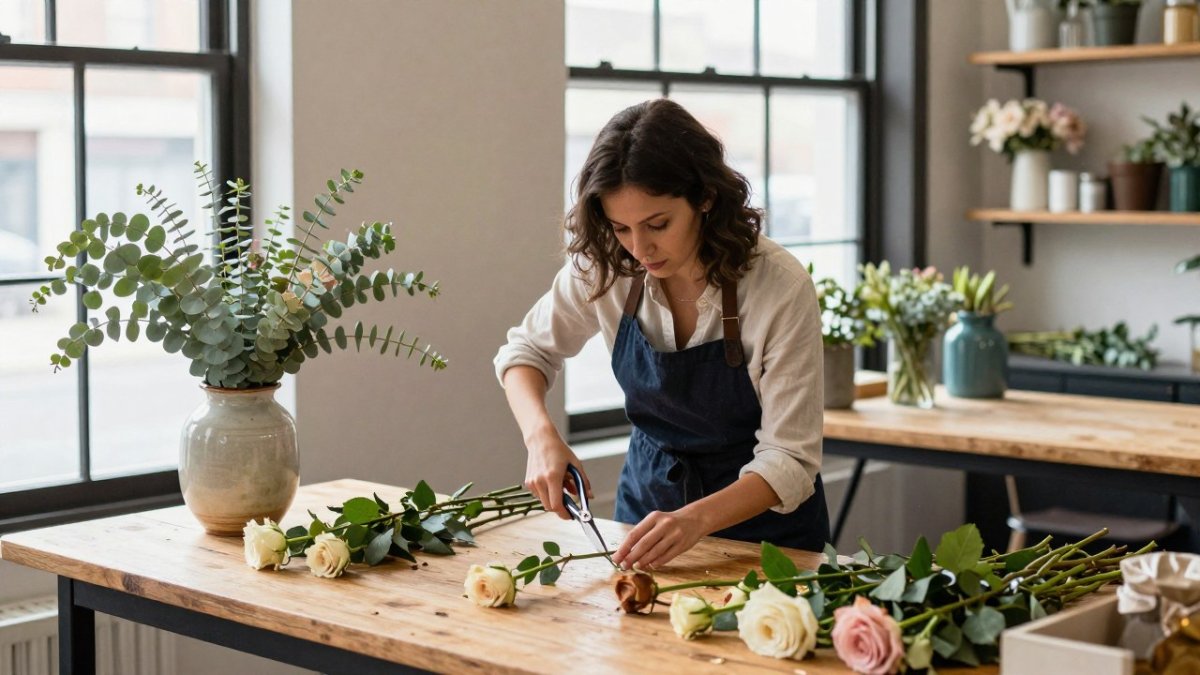
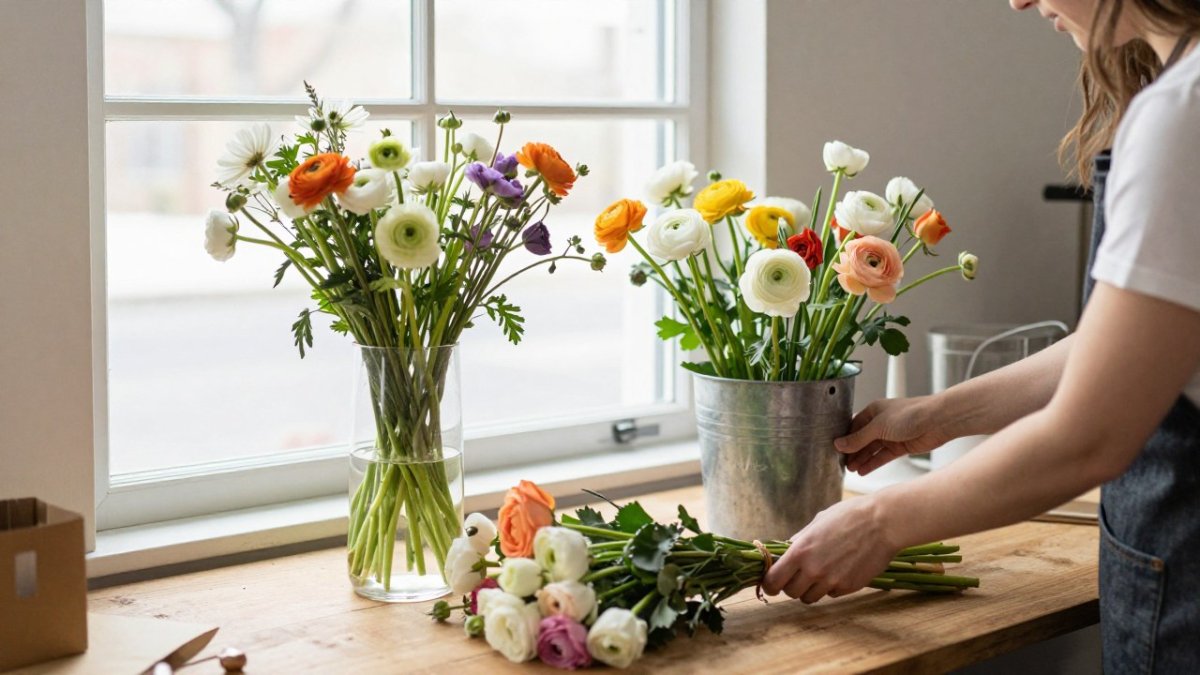
!Hands arranging a bouquet of fresh seasonal blooms on a wooden table in a bright florist workroom
Filler and Greenery: Baby's Breath, Yarrow, and Amaranth
Filler stems add volume and help your focal flowers stand out. Baby's breath and yarrow are widely available and affordable. Amaranth and gomphrena add texture and hold up well in warm rooms. Greenery such as eucalyptus adds structure and fragrance. Using a mix of fillers keeps arrangements full without relying on expensive focal stems.
How Far in Advance to Buy Flowers for an Event
Book your florist as early as possible, especially for peak wedding dates. Greenery and common fillers are usually easier to secure on shorter notice. Ask your florist when their supplier orders close, so your event does not fall between harvests.
Estimating Quantities and Budget by Event Size
Quantity depends on the size of your guest list, the number of tables, and how many arrangements you need. Start by counting centerpieces, bouquets, boutonnieres, and corsages, then build a stem estimate for each item before you ask for a quote. The ranges below are common planning figures most florists work from; confirm them against your specific design, since stem size and arrangement style move the numbers.
| Item | Typical Stem Count | Notes |
|---|---|---|
| Bridal bouquet | 15-30 stems | Larger, looser garden styles run higher |
| Bridesmaid bouquet | 8-15 stems | Scale to the bridal bouquet |
| Boutonniere | 1-3 stems | One focal bloom plus a sprig of greenery |
| Corsage | 2-4 stems | Add a ribbon or wristlet |
| Low centerpiece | 15-25 stems | Best for sightlines at seated dinners |
| Tall centerpiece | 25-40 stems | Needs a sturdy vessel and more greenery |
| Ceremony arch or arbor | 60-120 stems | Depends on coverage and whether greenery is reused |
| Bud vases (per table) | 3-5 stems each | A budget-friendly way to spread color |
Do the math by event size. For a seated dinner, plan one centerpiece per table of eight to ten guests, then multiply by the stem count for your chosen style. A 100-guest reception with ten tables and low centerpieces lands around 150-250 stems before personal flowers. Add bouquets, boutonnieres, and ceremony pieces on top. Cocktail-style events with bud vases often use fewer stems per table but more vessels, so count both.
What drives the budget. Pricing depends on quantity, dates, and delivery. Ask for a written estimate from The Flower Cart, Inc. so you can see where the cost goes.
A simple planning timeline. Six to nine months out, set the date and rough palette. Four to six months out, book the florist and confirm which focal flowers are realistic for your month. Two to three months out, finalize counts and place the order. Two to three weeks out, confirm delivery time, setup window, and a backup plan for any stem at risk. The day before, condition and store the flowers as directed. This sequence keeps seasonal stems from being ordered after the harvest window closes.
Visit The Flower Cart, Inc.'s website for current pricing or to request a quote tailored to your event.
Where to Buy Fresh Seasonal Flowers for Events
Local florists usually offer the most seasonal selection because they work with nearby growers and can advise on what is in bloom. National delivery services can work for simpler orders, but local sourcing tends to mean fresher stems and more direct guidance on timing. Compare a local florist's seasonal stock list with the options you see elsewhere before deciding.
Booking Your Event Flowers With The Flower Cart
Our team at The Flower Cart, Inc. can help you match blooms to your date and colors. Start with a how to order hospital appropriate flowers guide if your event takes place in a clinical setting, or read our tips for ordering event floral designs to plan your order from start to finish. Our second-generation family team has served Baltimore since 1961, so reach out early and we'll help you build the right plan for your celebration.
Frequently Asked Questions
How far in advance can I buy fresh flowers for an event?
Most event florists recommend ordering fresh seasonal flowers several weeks ahead, especially for weddings and large gatherings. Popular focal flowers such as peonies and ranunculus have shorter seasons, so booking early secures the blooms you want. Common-stock flowers and greenery are often available year-round, which gives you more flexibility. Confirm delivery or pickup timing with your florist, since flowers are usually harvested or ordered only a few days before the event to stay fresh. Pricing depends on quantity, dates, and delivery, so request a quote from The Flower Cart, Inc. directly.
What flowers are in season right now?
Seasonal availability changes each month and by region. Spring typically brings tulips, ranunculus, and peonies, summer offers roses, gerbera daisies, and asters, and fall favors dahlias, yarrow, and amaranth. Many popular flowers and greens are available year-round, so you can mix seasonal focal blooms with dependable filler. Ask your florist what is currently being harvested, since availability shifts from week to week. Choosing flowers that match the season usually gives you fresher stems and more design options for your event.
How should I store flowers before an event?
Keep fresh-cut flowers cool, out of direct sunlight, and away from ripening fruit, which releases ethylene gas that shortens vase life. Recut stems at an angle and use clean water with flower food if you have it. Store arrangements in a cool room or refrigerator if your florist recommends it, and avoid freezing. Delicate blooms like peonies should be kept cool until the event. Ask your florist for specific care instructions for your chosen varieties.