 How-to
Tips for Fresh Flower Care 2026
Table of Contents
- Start with a Clean Vase and Fresh Water
- How to Trim Flower Stems for Maximum Hydration
- How Often to Change Flower Water
- Homemade Flower Food vs. Store-Bought Options
- How Long Do Cut Flowers Last with Proper Care
- Troubleshooting Wilting and Other Common Problems
- Creating the Right Environment for Your Bouquet
- Frequently Asked Questions
Last Updated: October 16, 2026
Start with a Clean Vase and Fresh Water
The foundation of fresh flower care begins before your blooms touch water: a clean vase is non-negotiable, since bacteria and residue from previous arrangements shorten flower life dramatically.
Wash the vase with warm soapy water and a bottle brush, then rinse completely. For extra assurance, disinfect with a dilute bleach solution (one part bleach to nine parts water), let it sit a few minutes, then rinse until no bleach smell remains.
Fill the clean vase with fresh, cool water, cool water slows bacterial growth and helps flowers absorb hydration more efficiently. Fill it about three-quarters full, leaving room for daily top-ups.
A genuinely clean vase makes a measurable difference in how long cut flowers last, the simplest step, and the most overlooked.
How to Trim Flower Stems for Maximum Hydration
Trimming stems properly opens the vascular system so flowers can drink efficiently. Dull scissors crush stem tissue and block uptake; sharp scissors make a clean cut that allows maximum hydration.
Cut stems at a 45-degree angle with sharp, clean scissors or a knife, the angled cut creates more surface area for absorption than a straight cut. Remove about one-quarter to one-half inch from each stem.
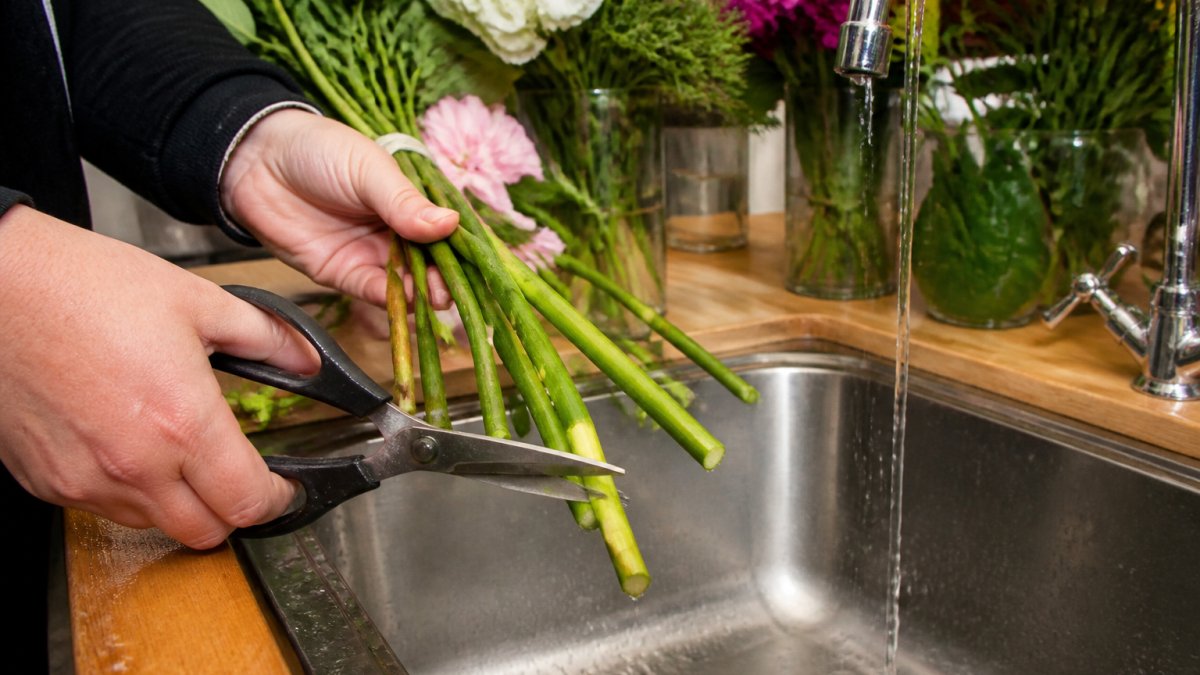
Strip away any leaves that would sit below the waterline. Submerged leaves decompose quickly, creating bacteria that clogs the stem and blocks uptake.
Trim your stems every two to three days. Each trim removes accumulated dead tissue and opens a fresh surface for water absorption, one of the most effective ways to extend vase life, and one many people skip.
How Often to Change Flower Water
Change your flower water completely every two to three days, don't just top it off. Remove the arrangement, empty and quickly wash the vase, refill with fresh cool water, and return the flowers.
Changing water removes bacteria, wilted petals, and debris that cloud the water and feed bacterial growth, while fresh water delivers oxygen and nutrients that keep blooms vibrant. Bacteria in stagnant water blocks the stem's ability to absorb water, which is why flowers droop even when surrounded by liquid.
Set a phone reminder if you tend to forget, consistency matters more than perfection. Roses and carnations tolerate slightly longer intervals; tropical blooms prefer more frequent changes. When in doubt, change it every two to three days.
Homemade Flower Food vs. Store-Bought Options
Most guides say "add flower food" or "try sugar and bleach" and stop there, leaving contradictory advice and no way to judge which recipe works. Here's the mechanism behind each ingredient.
What commercial flower food actually does
A standard packet contains three components, each solving a different problem:
- A sugar source (usually sucrose or dextrose) feeds the flower. Cut stems are severed from the plant that produced their food, so they burn through stored carbohydrates within a few days. Sugar replaces that energy and delays senescence, the natural aging process that makes petals fade and drop.
- An acidulant (often citric acid) lowers the water's pH. Cut stems take up water most efficiently in slightly acidic conditions, roughly pH 3.5 to 5.0. Tap water in many areas runs neutral to slightly alkaline, which slows uptake.
- A biocide (often a quaternary ammonium compound or a mild bleach-type agent) suppresses the bacteria and yeast that colonize the water and clog the stem's vascular tissue.
All three matter. Skip the sugar and flowers starve. Skip the biocide and bacteria win. Skip the acidulant and uptake slows. That's why a balanced packet outperforms a single-ingredient home remedy.
The DIY recipes, ranked by how well they mimic the real thing
Sugar plus bleach (closest to commercial). Roughly one tablespoon of sugar and a few drops of household bleach per quart. The sugar feeds, the bleach suppresses bacteria. The weakness: bleach is easy to overdose and too much damages stem tissue, so use a light hand.
Sugar plus vinegar or lemon juice (partial match). One tablespoon of sugar plus a tablespoon of vinegar or lemon juice per quart. The acid lowers pH and the sugar feeds, but neither fights bacteria, so water clouds faster, change it more often than with a packet.
Lemon-lime soda (sugar and acid, no biocide). About one-quarter cup per quart. The sugar and phosphoric acid help, but soda also feeds bacteria and mold, and sugar concentration is hard to control. Treat it as a stopgap, not a routine.
Aspirin, pennies, and vodka (weak or unproven). Aspirin is a mild acid but does nothing for bacteria or energy. A copper penny was once thought to act as a biocide, but modern pennies are mostly zinc.
The honest verdict
If you have a commercial packet, use it, it's the most reliable, purpose-formulated option. If not, sugar plus a few drops of bleach per quart is the closest home approximation. Whatever you use, the water-change schedule matters more than the additive: a clean vase with plain fresh water changed every two to three days will often outperform a dirty vase with a perfect packet.
How Long Do Cut Flowers Last with Proper Care
Ranges are useful, but they don't tell you what to do on day four. Here are realistic longevity expectations paired with a day-by-day care timeline.
Realistic vase-life ranges
These are typical ranges for flowers that arrive fresh and receive consistent care; a bloom already several days old on arrival will land at the low end.
- Roses, carnations, chrysanthemums: 10 to 14 days. These are the workhorses of the cut-flower world, woody or semi-woody stems, moderate water demand, and good tolerance for a two-to-three-day water-change cycle.
- Tulips and daffodils: 7 to 10 days. Both continue to grow and bend after cutting, and daffodils release a sap that harms other flowers, so keep them in their own vase.
- Hydrangeas and orchids: 2 to 3 weeks under ideal conditions. Hydrangeas drink heavily and wilt fast when they dry out; orchids are slow metabolizers and reward cool, stable temperatures.
- Dahlias and zinnias: 5 to 7 days. Soft, hollow stems make them prone to bacterial blockage, so they benefit from more frequent re-cutting than sturdier blooms.
- Lilies and alstroemeria: 7 to 14 days. Both are long-lasting, but lilies drop pollen that stains, so remove the anthers as buds open.
A day-by-day care timeline
Day 0 (arrival). Unwrap, remove all leaves below the waterline, and re-cut each stem at a 45-degree angle with sharp scissors. Fill a clean vase three-quarters full with cool water and add flower food if you have it.
Day 1. Check the water level and top up if needed. Look for any leaves that have slipped below the waterline and remove them.
Day 2 to 3. Full water change: empty and rinse the vase, refill with fresh cool water, re-cut stems about a quarter inch, and re-add flower food. This is the single most important maintenance day.
Day 4 to 6. Repeat the water change and re-cut. Remove spent blooms, they release ethylene and speed the decline of nearby flowers. If water clouds before day three, change it sooner; cloudiness means bacteria are ahead of you.
Day 7 onward. Continue the two-to-three-day cycle. Expect the most delicate blooms to fade first; pull declining flowers so the rest get more room and less ethylene exposure.
How to tell if you're on track
Use these checkpoints to diagnose your routine:
- Stems still firm and water clear at day three: your care is working.
- Water cloudy before day three: you're under-changing, or leaves are sitting below the waterline.
- Flowers drooping by day four or five: bacterial blockage, re-cut and change water immediately.
- Petals browning or dropping early: ethylene exposure or heat. Move the arrangement away from fruit, vents, and sun.
If your flowers consistently land at the low end of their range, the usual culprit is water freshness or stem trimming, not the flowers themselves.
Troubleshooting Wilting and Other Common Problems
Wilting is the most common complaint, and it usually points to one of three issues.
Flowers droop but stems feel firm: This signals bacterial blockage in the stem. The flower has water around it but can't absorb it.
Flowers droop and stems feel soft or mushy: The stem has rotted, usually from leaves sitting in water or water that hasn't been changed. Solution: remove the affected flower.
Petals fall or brown quickly: This indicates exposure to ethylene gas, heat, or direct sunlight. Ethylene gas comes from ripening fruit, heating vents, and air conditioning units. Keep flowers away from fruit bowls, direct airflow, and sunny windowsills.
Flowers look limp but water level is fine: Check water temperature. Cold water (just from the tap) can shock delicate blooms temporarily. Room-temperature water is gentler.
Stems are slimy or water smells foul: Bacteria has taken over. This happens when water isn't changed frequently enough or the vase wasn't properly cleaned.
The good news: most problems are preventable with consistent water changes and proper stem trimming. Troubleshooting is only necessary when care lapses.
Creating the Right Environment for Your Bouquet
Temperature and light are the two environmental factors that most influence how long flowers stay fresh and vibrant.
Keep flowers in a cool location, ideally between 65 and 75 degrees Fahrenheit. Cool temperatures slow the metabolic processes that cause blooms to age.
Direct sunlight fades color and causes flowers to wilt faster. Place your bouquet in a spot with bright, indirect light. A table near a window with sheer curtains is ideal.
Avoid locations with drafts. Doors that open frequently, ceiling fans, and heating vents create temperature swings that stress flowers. Also keep flowers away from ripening fruit and vegetables.
If you have multiple bouquets, group them together. Flowers release ethylene gas as they age, so clustering arrangements concentrates that gas and speeds aging.
One practical tip: if your home is consistently warm, move the arrangement to a cool closet or basement overnight.
Getting fresh flower care right isn't complicated, but it does require consistency. The steps, clean water, trimmed stems, regular water changes, proper temperature, and indirect light, work together to keep your blooms looking vibrant.
Frequently Asked Questions
How often should you change the water in a flower vase?
Change the water in your vase every two to three days. Fresh water prevents bacterial buildup that blocks water uptake and causes wilting. When you change the water, also rinse the vase with warm soapy water and re-cut about 1 inch from the bottom of each stem at a 45-degree angle. This combination keeps your cut flowers vibrant for a full week or longer.
How do you make homemade flower food?
Mix one tablespoon of sugar, one-quarter teaspoon of bleach, and one quart of water. The sugar feeds the blooms, and the bleach inhibits bacterial growth. Alternatively, use one tablespoon of white vinegar and one teaspoon of sugar per quart of water. Both recipes work well for most fresh flowers. Change this solution every two to three days along with your water changes for best results.
Why are my cut flowers wilting so quickly?
Wilting usually results from bacteria in the water, air pockets in the stems, or improper water uptake. Ensure your vase is clean, change water every two to three days, remove leaves below the waterline, and re-cut stems underwater at a 45-degree angle. Keep flowers away from direct sunlight, heating vents, ripening fruit, and temperature fluctuations. If stems are drooping despite these steps, try placing the bouquet in cool water for a few hours to rehydrate.
How long do cut flowers last with proper care?
Most cut flowers last 7 to 12 days with consistent care, though some varieties like roses and carnations can last up to two weeks. Tropical blooms and hydrangeas may have shorter vase lives of 5 to 7 days. Proper care includes using a clean vase, fresh water changed every two to three days, flower food, re-cut stems, and keeping blooms in a cool location away from direct sunlight and ethylene gas from ripening fruit.