 How-to
How to Trust Online Florist Photos Before You Order
Last Updated: October 30, 2026
Quick Summary
To trust online florist photos, check whether the images show the shop's own work rather than stock or catalog pictures, using a reverse image search and looking for real workroom shots and recent customer photos. Photos show one arrangement on one day, and substitutions are common, so also confirm the florist is a real local business and read its substitution policy before paying.
- Run a reverse image search; if the same photo appears on unrelated florist sites, treat it as a catalog image.
- Look for multiple angles, a real workroom setting, and recent customer photos of delivered bouquets.
- Confirm a physical street address and working phone number, and check that the address matches a real storefront.
- Read the substitution and refund policy before checkout, not after a disappointing delivery.
- Photograph the bouquet, packaging, and delivery timestamp, and save the original listing if the delivery doesn't match.
Table of Contents
- Step 1: Check Whether the Photos Show the Florist's Own Work
- Step 2: Verify the Florist Is a Real, Local Business
- Step 3: Read the Substitution and Refund Policy Before Checkout
- Step 4: Understand Seasonal Availability and Bouquet Variation
- Step 5: Compare the Delivered Bouquet Fairly and Document Any Mismatch
- Booking Your Next Arrangement With Confidence
- Frequently Asked Questions
Online flower shopping is growing fast. Online flower shopping is growing, and more shoppers are choosing an online florist based on photos alone. The catch is that a photo shows one arrangement on one day. Your delivery is a different bouquet, made by a different person, from whatever flowers were available that week.
We at The Flower Cart, Inc. think shoppers deserve a clear way to judge a florist before they pay. This guide walks you through five practical checks you can run in about ten minutes.
Here is the honest reason photos and deliveries differ. Flowers are seasonal and perishable. A designer may swap a rose for a similar bloom, change the filler greenery, or pick a larger or smaller vase. Even a skilled florist can't guarantee an identical match.
Watch out: A stunning photo can hide a generic bouquet. If the arrangement looks too perfect to be real, check the next step before you order.
Step 1: Check Whether the Photos Show the Florist's Own Work
Start with the photos themselves. Some florist websites use stock images, wire-service catalog pictures, or manufacturer-supplied product shots rather than photos of arrangements the shop actually made. A single reused image can appear on many unrelated florist sites, which means the photo may not show what that shop will deliver.
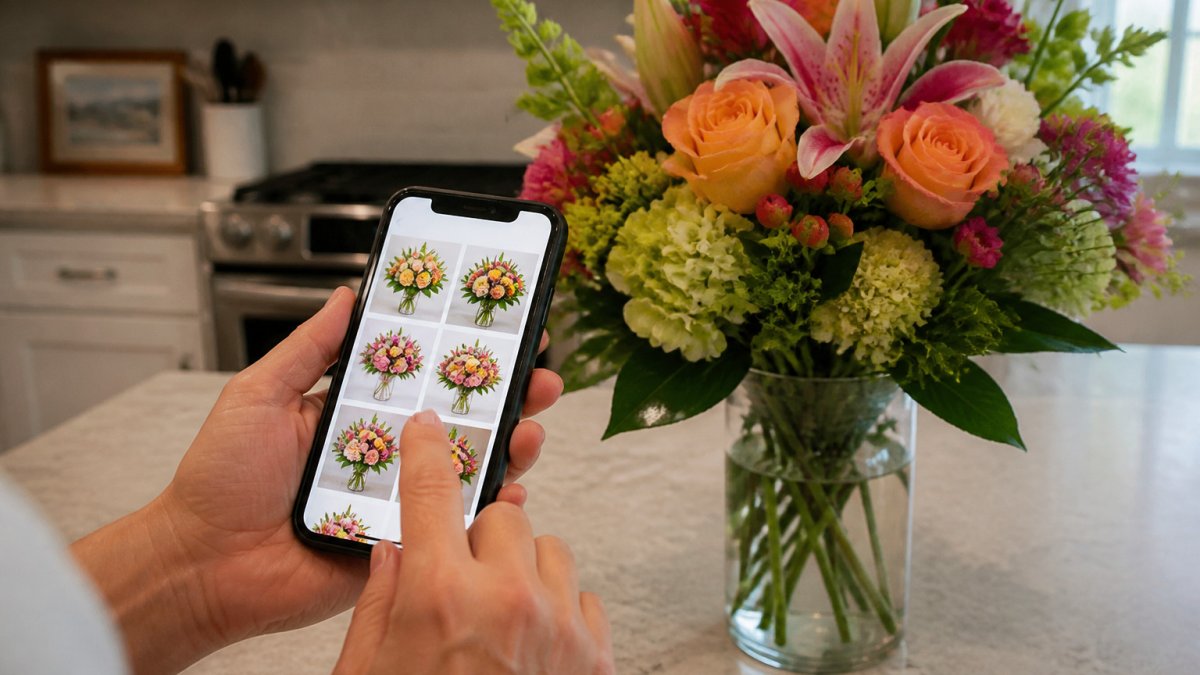
Run this photo-authenticity checklist before you trust a gallery:
- Look for a real workroom. Photos taken in a shop or on a design bench are more likely to be the florist's own work than studio shots on seamless white backdrops.
- Check for multiple angles. A genuine product photo usually shows the arrangement from more than one side; a single flat catalog image reused across many products is a warning sign.
- Scan for repeated images. If the same bouquet photo appears under several product names or price tiers, the shop is likely recycling a supplier image rather than photographing its own designs.
- Look for inconsistent backgrounds. A gallery that mixes dramatically different lighting, backdrops, and prop styles often signals images pulled from multiple stock sources rather than one shop's consistent photography.
- Hunt for customer-submitted photos. Recent photos from buyers showing delivered bouquets are the strongest evidence of what the shop actually produces.
Browse the florist's social media as a second check. Shops that regularly post their work, such as arrangements on the design table, tend to be showing their own designs. Look at the dates: a feed that stops months ago or only reposts supplier graphics is weaker evidence than a steady stream of recent, varied arrangements.
Google Images reverse image search
A photo that survives this checklist, real workroom setting, multiple angles, no reuse across unrelated sites, and recent customer photos, gives you a far better basis for judging what will arrive than a polished catalog shot alone.
Step 2: Verify the Florist Is a Real, Local Business
A website alone doesn't prove a florist exists. That is a common source of mismatched bouquets.
To check a florist:
- Look for a physical street address and a working phone number
- Confirm the address on a map and see if it matches a real storefront
- Read recent reviews, and look for complaint patterns about the same issue
- Ask who will actually make your arrangement
If the shop is local, a quick call can tell you a lot. You can ask about the designer, the delivery area, and how they handle substitutions.
Step 3: Read the Substitution and Refund Policy Before Checkout
Substitutions are the most common reason a delivery looks different from the photo. Read the policy from any online florist photos listing before you pay, not after a disappointing delivery.
Check for these details:
- Whether the florist substitutes flowers, and what they substitute with
- Whether substitutions use similar colors and sizes
- How the shop handles vase or container changes
- The refund or replacement process if the bouquet doesn't match
Clear policies are a good sign, so consider contacting any florist with questions before you order.
Step 4: Understand Seasonal Availability and Bouquet Variation
Flowers change with the seasons. A bouquet photographed in June may not be possible to recreate in January. Good florists use what is fresh and local, which means the exact blooms can shift.
Keep these expectations in mind:
- Peak-season flowers are easier to match
- Off-season orders may use different blooms in the same color family
- Bouquet size and shape can vary slightly by design
- Ask whether the photo shows a seasonal design
A florist who explains seasonal limits up front is usually easier to trust than one who promises an exact match year-round.
Step 5: Compare the Delivered Bouquet Fairly and Document Any Mismatch
When your order arrives, compare it to the photo with realistic expectations, but compare it fairly. Focus on the overall look, color palette, and bouquet size rather than on every single petal. A substitution that keeps the color family, stem count, and arrangement shape is usually acceptable; a bouquet that arrives in a different color, at half the size, or in a materially different style is not.
Use this fair-comparison framework:
- Color: Does the delivered palette match the photo's dominant colors, or did the shop swap a warm bouquet for a cool one?
- Stem count and size: Does the bouquet look comparable in volume and height, or visibly smaller than the photo suggests?
- Shape and style: Is it still a rounded hand-tied bouquet, a vase arrangement, or a basket as pictured, or has the form changed?
- Value: Would a reasonable shopper say they received roughly what they paid for, given the substitutions made?
If the delivery truly doesn't match, collect evidence right away, the same day if possible, while the flowers are fresh and the packaging is intact:
- Photograph the bouquet from several angles in good natural light, including a top-down shot and a side view.
- Photograph the packaging, card, and delivery timestamp so the delivery can be tied to your order.
- Save the listing. Take a screenshot of the original product photo and description, plus your order confirmation and receipt.
- Write a short note of what differs, flower type, color, size, stem count, or container, and compare it line by line to the listing.
- Contact the florist promptly within the time window stated in their policy, and share your evidence calmly.
Most shops want to fix the problem, and clear documentation makes that much easier. If a shop is unresponsive, escalate in writing and keep a record of each contact. If a delivery materially differs from what was advertised, your best first step is a documented, polite request to the seller.
FTC guidance on deceptive advertising
Clear documentation protects you whether the shop resolves the issue quickly or you need to escalate later.
The article lists what makes a substitution acceptable versus a materially different product.
| Factor | Acceptable substitution | Materially different |
|---|---|---|
| Color | Same color family | Different color palette |
| Stem count and size | Comparable volume and height | Visibly smaller than the photo suggests |
| Shape and style | Same arrangement shape | Different form than pictured |
| Container | Similar vase or basket | Different container style than pictured |
| Overall value | Roughly what was paid for | Clearly less than what was paid for |
Booking Your Next Arrangement With Confidence
Trusting an online florist comes down to a few habits: check where the photos came from, confirm the shop is real, read the substitution policy, and keep your expectations seasonal. Shoppers who do this avoid most surprises.
If you're ready to order, visit The Flower Cart, Inc. online to browse our arrangements and request current pricing. We're a second-generation family florist serving Baltimore since 1961, and our team can help you understand what your bouquet will include.
Frequently Asked Questions
How can you tell if an online florist's photos are real?
Look for photos that appear to be taken by the shop itself: consistent lighting, the same vases and packaging across images, and arrangements that match the shop's social media posts. Stock or wire-service images often look polished but generic, and the same image may appear on several florist sites. Ask the florist directly whether the photos show their own work, and compare the photos with customer-submitted images on reviews or social media. A shop that is willing to show real completed orders is usually easier to trust.
What should you check before ordering flowers online?
Confirm the florist has a physical address and a working phone number, read the substitution and refund policy, and check the delivery cutoff time for same-day orders. Ask what happens if a flower is out of season, and whether the shop will send a photo of the finished arrangement before delivery. Reading recent reviews for complaint patterns about mismatched bouquets is also useful, since it shows how the shop handles problems in practice.
Can a florist substitute flowers shown in a photo?
Many florists reserve the right to substitute flowers when a specific bloom is unavailable, because flowers are seasonal and supply varies. A substitution should generally be of similar color, size, and value, and the photo is usually presented as a guide rather than a guarantee. Check the policy before checkout, and ask whether you can request a specific substitution or be notified before one is made for an occasion where the exact look matters.
What should you do if delivered flowers don't match the website photo?
Take clear photos of the delivered arrangement from several angles and keep the order confirmation, the product photo you ordered, and any messages with the florist. Contact the shop promptly and describe the specific differences, such as bouquet size, flower types, or container. Most florists will want to resolve the issue, whether through a replacement, partial refund, or credit. Keeping written records makes the conversation faster and more productive.