 How-to
5 Steps to Send Flowers to Johns Hopkins Hospital
Last Updated: October 25, 2026
Quick Summary
Flower delivery Johns Hopkins requires confirming the patient's unit allows flowers, as intensive care, transplant, oncology, and immunocompromised units often prohibit fresh flowers due to infection risk. Call the hospital's main line and speak with the charge nurse to verify the patient can receive flowers before placing your order.
- Call Johns Hopkins to confirm the patient's unit and any flower restrictions before ordering
- Intensive care, bone marrow transplant, oncology, and organ transplant units commonly prohibit fresh flowers
- Potted plants, balloons, sealed snacks, and cards are often accepted when fresh flowers are not permitted
- Same-day delivery requires ordering before the florist's morning cutoff, typically late morning
- Provide the patient's full name, unit or floor number, and room number for accurate hospital delivery
Table of Contents
- Confirm the Patient Can Receive Flowers at Johns Hopkins
- Understanding Hospital Flower Delivery Restrictions
- Best Flowers to Send to a Hospital Patient
- How to Address Flowers to a Hospital Patient
- Choosing Same-Day Flower Delivery to Johns Hopkins
- Writing a Get Well Soon Card Message for Flowers
- Placing Your Order with The Flower Cart
- Frequently Asked Questions
Confirm the Patient Can Receive Flowers at Johns Hopkins
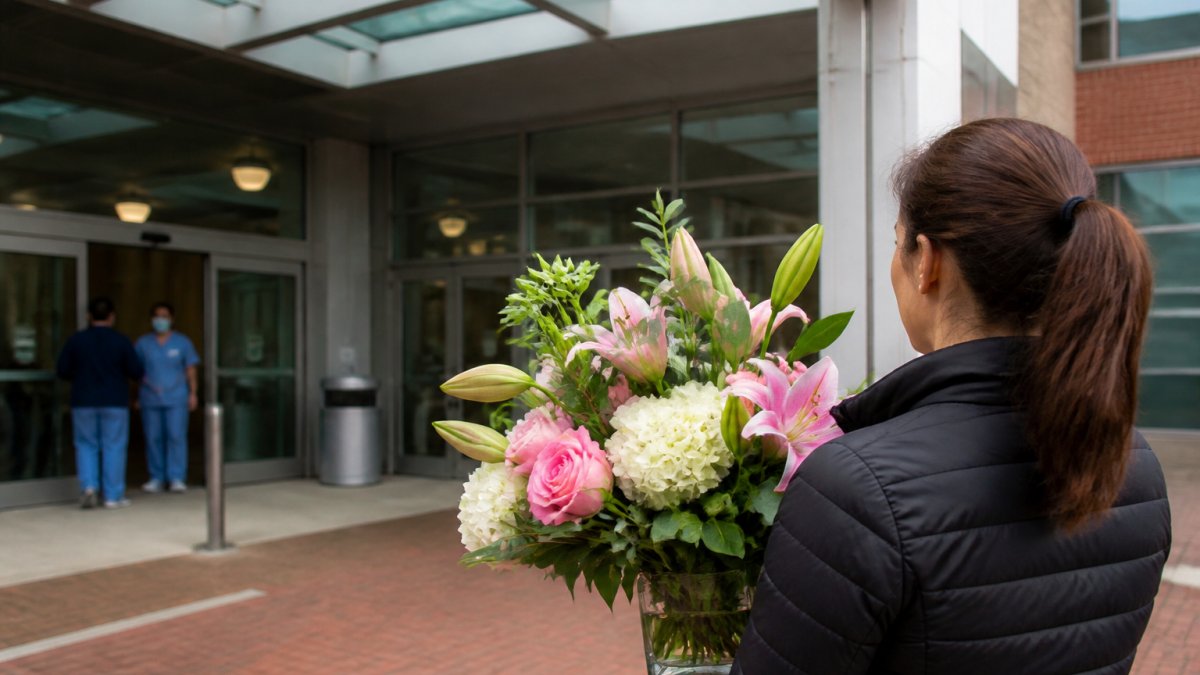
Before you order flower delivery Johns Hopkins Hospital, verify that the patient is actually allowed to receive them. Hospital policies vary by unit, and some patients cannot have fresh flowers in their rooms due to medical restrictions.
Call Johns Hopkins directly at the main hospital line to confirm the patient's current location and any flower delivery restrictions.
Once you've confirmed flowers are permitted, you'll know exactly where to send them and what details matter most for your order. This simple step prevents the disappointment of flowers being rejected at the hospital or returned to the florist.
Understanding Hospital Flower Delivery Restrictions
Hospital flower restrictions are not arbitrary, they exist because fresh flowers, vase water, soil, and pollen can introduce bacteria, mold spores, and allergens into units where patients have weakened immune systems or compromised lungs.
The units most likely to prohibit or limit fresh flowers include:
- Intensive care units (ICU) and cardiac care units
- Bone marrow and stem cell transplant units
- Oncology floors where patients are neutropenic
- Organ transplant and immunocompromised patient areas
- Immediately post-operative recovery rooms
- Certain respiratory, isolation, and infection-control units
A common pattern is that cut flowers and vase water are barred while potted plants, sealed gourmet gifts, cards, and balloons may still be allowed, but the reverse is also true on some floors, where soil is the concern and cut flowers are fine. Do not assume; confirm.
How to confirm a specific patient can receive flowers
Before you order, call the hospital's main line and ask to be transferred to the patient's unit. Speak with the charge nurse or unit clerk rather than a general operator, and ask three questions:
- Is this patient currently allowed to receive fresh flowers, potted plants, or both?
- Is the patient in a private room, and can gifts be brought to the bedside?
- Is there a receiving desk or volunteer office where deliveries are held?
Patient condition can change day to day. A patient who was in a restricted unit yesterday may have been transferred, and a patient whose counts have dropped may have had flowers removed from the room. If your order is more than 24 hours out, re-confirm on the morning of delivery.
Alternatives when flowers are not permitted
When fresh flowers are off the table, these options are commonly accepted and still feel personal:
- Potted plants, orchids, succulents, and small green plants are permitted in many units that bar cut flowers, though soil restrictions apply in transplant and some oncology units.
- Sealed snacks and gourmet gifts, individually wrapped items are often allowed where open food is not; check for dietary restrictions first.
- Cards and letters, always permitted, and often the item patients keep longest.
- Balloons, mylar balloons are widely accepted; latex is banned in many hospitals due to allergy risk.
- Non-floral gift baskets, puzzle books, toiletries, and comfort items.
Ask the unit which of these are allowed before ordering, and tell your florist which category you are choosing so the arrangement, card, and packaging match what will actually be accepted at the bedside.
Best Flowers to Send to a Hospital Patient
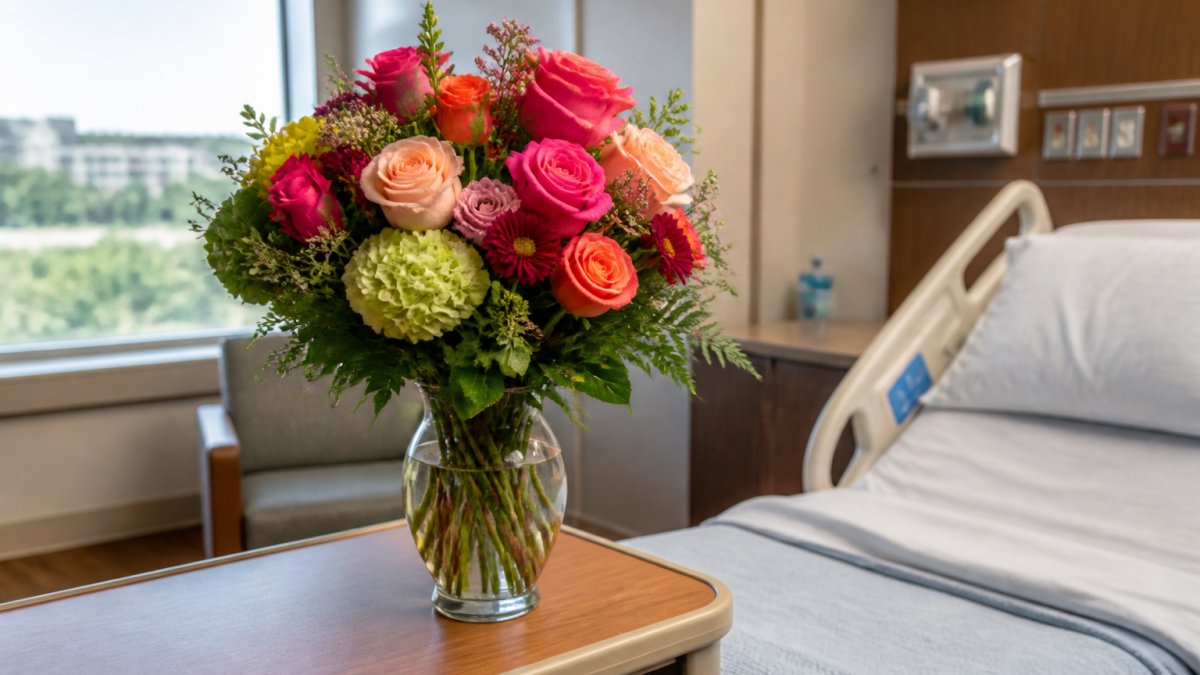
The best flowers for a hospital patient are fresh, long-lasting blooms that brighten the room without overwhelming a recovering person.
Avoid heavily scented flowers if possible, strong fragrances can trigger headaches or nausea in patients recovering from surgery or illness. Choose arrangements with a mix of colors that feel uplifting but not jarring.
Hospital rooms are typically small, so a medium-sized arrangement (12-18 inches tall) fits better than an oversized display.
When you order through The Flower Cart, Inc., our floral designers create hospital-appropriate arrangements using fresh, seasonal blooms from local Maryland farms.
How to Address Flowers to a Hospital Patient
Getting the delivery address right ensures your flower delivery Johns Hopkins actually reaches the patient. Hospital flower delivery requires specific information beyond a standard home address.
Some hospitals use a delivery-to-bedside system where flowers are brought directly to the patient's room. Others require flowers to be left at a central receiving area or with nursing staff.
Double-check the spelling of the patient's name and confirm the room or unit information is current.
Choosing Same-Day Flower Delivery to Johns Hopkins
Same-day delivery to a hospital is possible, but it depends on three things lining up: the order is placed before the florist's cutoff, the arrangement is in stock or can be built quickly, and the patient's unit is reachable on that day's route. Understanding how those pieces interact is what separates a smooth delivery from a missed one.
How same-day cutoffs actually work
Most local florists set a morning cutoff, commonly late morning, for same-day delivery, and orders placed after it roll to the next business day. Two caveats matter for hospital orders:
- Cutoff is not the same as delivery time. An order placed at 10 a.m. may still be delivered in the afternoon, after the florist's route is built. Ask for the delivery window, not just the cutoff.
- Hospital routes often run once. Many florists make a single daily run to a large medical campus. If your order misses that run, it waits until the next day regardless of when you placed it.
If the patient is being discharged, transferred, or scheduled for surgery, tell the florist at the time of order. A delivery that arrives after discharge is the most common failure mode for hospital flower orders.
What same-day delivery actually costs
Displayed product prices are rarely the final total. Expect the checkout to add:
- Delivery fee, varies by arrangement size and delivery zone; hospital campus deliveries sometimes carry a premium because of the time spent navigating buildings and units.
- Sales tax, applies to the arrangement and typically to the delivery fee as well, depending on state rules.
- Card and vase charges, some listings bundle these, some add them at checkout.
- Rush or timed-delivery fees, if you need a specific window rather than the next available delivery.
Before you pay, confirm the all-in total and ask whether the delivery fee is refunded if the order cannot be delivered.
Reliability and failed-delivery handling
Hospital deliveries fail for predictable reasons: the patient was discharged, transferred to a restricted unit, the room number was wrong, or the unit refused the arrangement. Protect yourself with these steps:
- Give the florist a backup contact. A family member's mobile number lets the driver resolve a wrong room or a transfer instead of returning the arrangement.
- Ask for delivery confirmation. Request a confirmation, call, text, or email, when the arrangement is accepted at the unit, not just when it leaves the shop.
- Know the redelivery policy. Ask whether a failed delivery is redelivered free, redelivered for a second fee, or refunded minus delivery.
- Have an alternate recipient ready. If the patient cannot receive flowers, a family member, the nurses' station, or a waiting room may be able to accept them, confirm with the unit first.
Hospital florist vs. local florist vs. third-party delivery
The three main options differ in ways that matter for a hospital order:
- Hospital-operated or on-campus florist, fastest access to the building and familiarity with unit rules, but limited product range and hours.
- Local independent florist, broader selection and customization, with drivers who know the campus; quality depends on how often they run hospital routes.
- Third-party gift and flower delivery platforms, widest product range and easy online ordering, but the order is often fulfilled by a contracted local shop, which can add a handoff, delay confirmation, and complicate refunds if something goes wrong.
Whichever you choose, ask the same three questions: What is today's cutoff? What is the all-in total? And how will I know the flowers were actually accepted at the unit?
Writing a Get Well Soon Card Message for Flowers
The card message matters as much as the flowers themselves. Keep it warm, sincere, and brief, hospital patients often feel tired or overwhelmed, and a short, heartfelt note means more than lengthy text.
A good get well soon card message includes:
- A personal greeting using the patient's name
- A genuine statement of care or support
- A specific reference to why you're sending flowers (recovery, encouragement, thinking of them)
- A simple closing with your name
Example messages:
- "Thinking of you during your recovery. These flowers are a small reminder that you're in our thoughts. Get well soon."
- "Wishing you strength and comfort as you heal. We're rooting for you."
- "Sending love and fresh flowers to brighten your room. Take care of yourself."
Avoid clichés, overly cheerful tones that might feel dismissive of the patient's condition, or anything that references the specific illness or injury. Keep the focus on recovery and your genuine care for them.
Placing Your Order with The Flower Cart
Ordering flower delivery to Johns Hopkins through The Flower Cart, Inc. is straightforward.
Provide the patient's full name, the specific unit or floor at Johns Hopkins where they're located, and your preferred delivery date and time window.
Confirm the total cost, including the arrangement, delivery fee, and any card message. We'll provide an order confirmation and delivery estimate.
For questions about what flowers are permitted, whether the patient can receive flowers, or to arrange a custom design, reach out to The Flower Cart, Inc. directly.
Sending flowers to someone at Johns Hopkins is a meaningful way to express care during recovery.
| Step | Details | Timeline |
|---|---|---|
| Confirm patient can receive flowers | Call Johns Hopkins to verify unit restrictions | Before ordering |
| Choose appropriate flowers | Select fresh, long-lasting blooms suitable for hospital rooms | When ordering |
| Get correct delivery address | Obtain patient name, unit, floor, and room number | Before ordering |
| Place order with florist | Provide delivery details and card message | Before 11 a.m. for same-day |
| Arrange delivery timing | Confirm same-day or next-day delivery window | At order placement |
Frequently Asked Questions
How do I confirm a patient can receive flowers at Johns Hopkins?
Call Johns Hopkins Hospital's main operator or the patient's specific unit to confirm they can accept flowers. Some units, particularly intensive care and isolation rooms, restrict flower delivery due to infection control or medical equipment concerns. Always verify before ordering. The Flower Cart can help guide you through this process when you place your order.
What flowers are best for hospital flower delivery?
Choose flowers without heavy fragrance, as strong scents can bother patients or interfere with medical equipment. Roses, sunflowers, gerbera daisies, and carnations are excellent choices. Avoid flowers that shed pollen (like lilies) or require frequent water changes. The Flower Cart sources fresh, seasonal blooms from local Maryland farms and can recommend arrangements specifically designed for hospital settings.
Can I get same-day flower delivery to Johns Hopkins?
Yes. The Flower Cart offers same-day flower delivery throughout Baltimore City and surrounding counties, including Johns Hopkins Hospital locations. Order before the cutoff time to guarantee same-day delivery. Contact The Flower Cart directly for current cutoff times and to confirm availability for your specific delivery date.
What should I include when addressing flowers to a hospital patient?
Provide the patient's full name, the hospital building or unit name, the patient's room number, and the hospital's address. Include a brief, encouraging message on the card. Avoid mentioning the diagnosis or anything that might upset the patient. The Flower Cart's team can ensure your delivery address is complete and accurate before your flowers are sent.